
All writing.
Browse by Theme
Starting Something New
Being first means inventing a category nobody else is playing in.
Open The Brand Strategy Guide →
Every sport had a first day. Someone invented a rule and did the thing before anyone alive had done it. The people who show up centuries later, the ones who look like they were built for the game, end up better at it than the person who made it up. Which raises a strange question for anyone building something. If going first leaves you worse at it than everyone who follows, why does it still matter more than being good?
The First Version of Anything Will Probably Suck
The man who invented basketball nailed a peach basket to a railing and never thought to cut a hole in the bottom. Every time someone scored, play stopped so a person could climb a ladder and fish the ball back out. The first version of the game was slow, awkward, and missing the parts that now look obvious. This is true of nearly everything that gets invented. The original is crude because the person making it had nothing to copy and no standard to chase.
James Naismith, who invented basketball in 1891, is the only coach in the University of Kansas program's history to finish with a losing record.
The runner at the center of the marathon legend, Pheidippides, reportedly collapsed and died the moment he finished, which is a strange origin story for an event people now train years for.
In early chess, the piece where the queen now stands could move only one square at a time, making it seem like one of the weakest pieces on the board. Today, it’s the most powerful piece in the game.
The inventors mattered anyway. The peach basket is the only reason there is a game to be good at. Every refinement that followed, the open net, the shot clock, the three-point line, was a correction applied to something that already had a shape. The first version looks clumsy because it is doing the hardest thing there is, which is going from nothing to something. Skill can only show up once that part is done.
Read More → Give Us Everything You’ve Got
Make It Look Natural
Nobody is born good at basketball. You're born with physical traits that the game happens to reward. A child who looks made for basketball was not designed by the universe to play a sport a gym teacher invented in 1891, they were born tall, or quick, or unusually good at tracking a moving object through space, and the game happened to reward exactly that. The talent feels natural because the structure was built, slowly and by many hands, to sit neatly on top of traits people already had. We see the fit and call it a gift.
A sport gets quietly reverse-engineered over time to reward whatever keeps winning, which is part of why the average height in professional basketball climbed for decades as the game matured.
The swimmers we call naturals tend to share measurable physical traits that no amount of training can install.
Left-handed athletes are overrepresented in sports with a direct opponent, like fencing, boxing, and baseball pitching, because their rarity is a structural edge that has nothing to do with effort.
This matters for brands too. The ones that feel inevitable are not lucky. They are built intentionally around what the founder is actually good at. You make choices about who you serve, what you say, and how you work, based on what comes naturally to you. When your structure matches your instincts, the fit looks like destiny.
Read More → Keep It You
Playing Someone Else's Game
Most small businesses are trying to be the best at something that already has a leader. The better coffee shop, the better consultant, the better studio. They take an existing category, study how the strongest player does it and try to do the same thing, but better. People can tell the difference between an original and a copy, no matter how polished the copy becomes. They can sense when something was invented versus when it was made to compete.
Your category can be tiny, a single intersection of two things nobody has combined before, and it still makes you the original instead of the imitation.
Being first does not require inventing a service nobody offers, it can mean being first to do a familiar one for a specific kind of person, in a specific place, with a specific point of view.
The roughness of an early version works in your favor here, because a brand that is first to something looks a little strange before it looks obvious, and sometimes strange is what people remember.
The first version of anything carries weight that refinement alone never produces. It resists change because it holds a shape that did not exist before it arrived. That is why the original tends to endure even after later versions get technically better. Everything afterward is quietly built on top of it, even when the copies are smoother, faster, or more polished. The structure came first, and the structure is what matters most.
Read More → Do Your Thing
At Relative Media, we start with your foundation because the best part of your business is the thing only you could have built. Everyone has something like that to offer. The hard part is finding it, and that's what the Brand Blueprint is for. When what you build finally matches who you are, you stop competing with everyone else and end up in a league of your own.
Begin a project → Book a Consult Deluxe
Discover → The Brand Blueprint
Relative Momentum: When Your Brand Forms A Life Of Its Own
Every brand eventually starts moving on its own. Here is how that momentum builds, why it feels strange when the brand is you, and how a clear foundation helps keep it yours.
Every brand reaches a point where it starts running on its own. Your work looks great without as much thought. You take a week off and nothing falls apart. Your brand finally has enough behind it to keep going without you having to push so hard. We call this Relative Momentum. It is what all that consistency was building toward, even when none of it felt like much at the time. The small push that first launches a brand and the current that later carries it are two different forces, and almost no one separates them. Sometimes watching it move on its own can feel unsettling, no matter what the brand is. When the brand is you, it can be stranger still.
How It Builds
For a long time, you are the one responsible for moving your brand forward. Every piece you put out, every conversation with a client, every design choice either fits the pattern or goes wildly off-brand. If all goes well, at some point, your brand keeps moving without you. We cannot tell you when that point will be. The timing has nothing to do with how many posts you have made or how long you have been in business, and it rarely lands on the day you would expect. More often, it shows up after something that felt completely unremarkable at the time. You catch it afterward, through a side effect: a referral from a stranger, your own words quoted back to you, the quiet realization that you are explaining yourself less and being understood more. By the time you can see it, it has already been true for a while. It is the whole accumulation finally reaching a weight that no one could have measured along the way.
Showing up consistently matters more than posting a lot.
The buildup isn’t tangible, so you rarely notice it happening.
Repeating one clear idea works better than introducing many new ones.
Brands with a clear foundation reach this point faster and need less fixing later.
This is Intel Dynamics at work. Clear, repeated input slowly turns into structure, and at some point, structured things start to function on their own. The patterns that make a brand recognizable only show up after enough real decisions to prove them, so most brands have to Give It A Second before the real thing reveals itself. You cannot claim it early or force it forward. What we can do is help you build on something solid from the start, so the momentum that forms is carrying the right thing. That is what the Brand Blueprint is for.
Existing On Its Own
For a company, the brand outgrowing any one person is the goal. For a personal brand, it feels different because you are the brand. Suddenly, people are talking about you and forming opinions, all from a small piece of what you have put out. They do it in rooms you are not in, and they do it while you are sitting right there, describing your work to each other like they are talking about someone else. You are still the source of it, but you are no longer steering every moment. Most people feel this as a loss of control, a version of them out in the world that anyone can shape but them.
Your name comes up in conversations you are not part of.
Something you posted months ago is still bringing people in.
Someone explains your work to a stranger and mostly gets it right.
People come out of the woodwork already knowing what you do.
Others repeat what you stand for and start doing it too.
You made something to represent you, and now it represents you without asking first. You cannot control how it gets read once it is moving, and fighting that only wears you down. What you can control is what you built into it, and that is the part out there doing the work.Keeping Your Personal Brand Yours is where that work starts.
It Gets Easier
At the start, everything you make begins from zero. You explain who you are, you build everything from scratch, and the return rarely matches the effort. Once your brand has momentum, that ratio inverts. Every new piece lands on top of everything that came before it, so it carries further than the last one did. Recognition compounds the same way, because each person who already gets it tends to bring the next one along. You are still doing the work. It just returns far more than it used to.
The grind early on does not predict the payoff later, the two phases are nothing alike.
Old work keeps earning, a piece from a year ago still brings people in and now carries the weight of everything made since.
New work inherits trust it never had to earn.
Referrals start generating referrals, since every new person who finds you is a potential source of the next.
This is what makes the early grind worth it. A brand built on something consistent appreciates, meaning the work you did last year keeps paying off while everything new compounds on top of it. This is also the long game behind What Makes A Simple Brand Work. Everything accumulates, and then it starts working on its own behalf. Brands that reach this point are the ones that stayed consistent long enough for the compounding to begin.
At Relative Media we do not deal in hypotheses, and we are not here to sell you a theory. Both of those come later, after a lot of guessing and testing. We work one step before either of them. We point out what happens every single time, no matter the industry or the size of the business. Relative Momentum is one of those things. The Brand Blueprint is where we capture these patterns for your brand, and the Consult Deluxe is where we point them out to you directly, early enough that you still get to choose the direction.
Begin a project → Book a Consult Deluxe
Discover → The Brand Blueprint
View the Relative Media Glossary
Short definitions, system terms, and working language.
See the full glossary here →
Read More
Niching Down Too Hard
Most small businesses get so specific with their branding that they accidentally build an audience of one. Learn how brand strategy helps you find the positioning that attracts real clients.
Everyone told you to niche down. Pick a lane and stay in it. Get specific and stop trying to talk to everyone. So you did. You got so specific that your entire brand now speaks to left-handed female entrepreneurs in coastal Florida who make artisanal hot sauce and need help with their quarterly tax filings. Congratulations. You have cornered a market of four people and two of them are your cousins. This post is about what happens when niching down stops being a strategy and starts being a personality disorder.
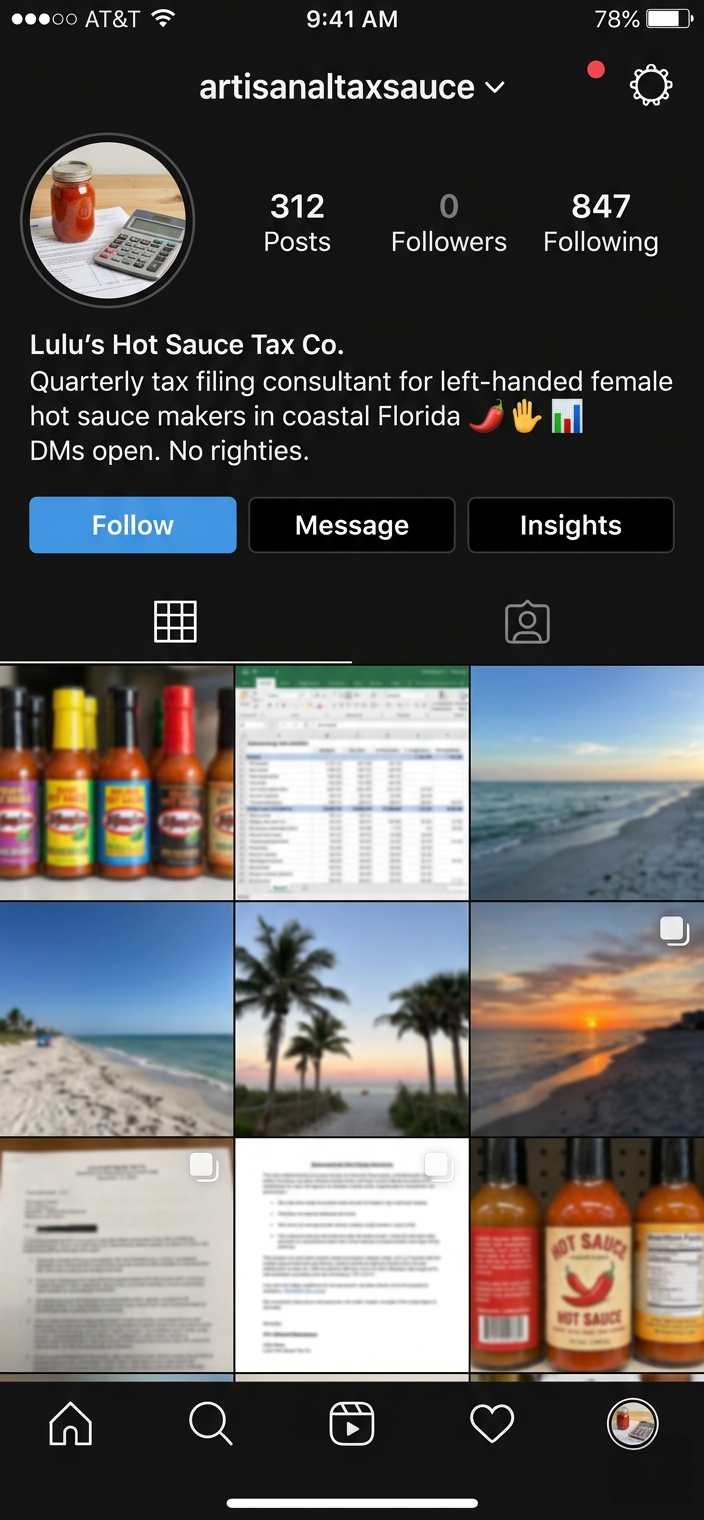
You're The Only One Who Finds It Interesting
There is a version of niching down that feels like genius from the inside and looks like a questionable disaster from the outside. The positioning seems airtight. The messaging is consistent. The visuals look immaculate. And yet there are six potential clients in the entire world who qualify. So instead of finding more clients, you write more content. Longer posts, deeper dives, more nuance, more explanation, because if you just explain it well enough surely someone will get it.
They won't.
You can be so specific that you're technically correct and practically invisible.
A niche that only you understand is not a niche, it's a concept.
Writing 4000 words about something three people care about is not content strategy, it's a journal.
If your ideal client has to be explained in four sentences, reconsider.
The most narrow niche in the world still needs an audience large enough to sustain a business.
One person who gets it (especially if that one person is you) is not a business model.
Read More → Defined By Default
The Content Gets Unhinged
This is where the chaos really starts. Because once the niche is too small to sustain itself, the content has to work harder. So it gets longer. More specific. More passionate. More convinced that the right angle is just around the corner. You're writing 1,500 word Instagram captions about the regulatory history of artisanal hot sauce labeling and tagging it #SmallBusiness. You have seventeen saves and fifteen of them are you checking to see if anyone saved it.
The content becomes a deeper and deeper explanation of something fewer and fewer people asked about.
Every post assumes a level of investment the audience never agreed to.
The passion is real but passion is not the same as relevance.
You start writing for the niche instead of for the person who has the problem.
At some point, the content stops being marketing and starts being a TED talk nobody signed up for.
This is usually the moment people think they need better content, but what they really need is better positioning. The Brand Blueprint is where that starts. It maps everything you need to know about what your content should be doing. When that exists, you stop writing into a void and start writing for people who are already looking for what you do. The content gets shorter, clearer, and more effective because it finally makes sense.
The Right Kind of Specific
The answer is not to go broad. Vague brands don't convert either. The difference is niching around the problem you solve instead of the identity of the person who has it. One is useful, the other is a personality quiz.
Niche around what you fix, not who you imagine fixing it for.
Get specific about your point of view, not your client's zip code and star sign.
Test it by asking if a stranger could understand your brand in one sentence.
The right niche makes people say "that's me" not "I wonder who that's for."
Broad enough to have an audience, specific enough to mean something.
When the positioning is right you don't have to work that hard. The right people find you, understand you, and don't need four paragraphs of context before they get it. That's what a niche is supposed to do, not narrow your audience into oblivion, but make the right audience feel like you're already talking to them.
Read More → The Right People
At Relative Media we help brands find the version of specific that actually works. Clear enough to attract the right people, but open enough to build a real business on. If your niche is starting to feel like a very niche problem, start with a Consult Deluxe and let's find the positioning that fits.
Read More
Artless
People say art imitates life, but some parts of life seem better when they remain artless.
Open the Brand Strategy Guide →
“Artless” is one of the few words we intentionally kept out of our glossary because we can’t decide what it means. Sometimes it describes something honest, unaffected, and free from performance. Other times it describes something careless, automatic, or entirely unexamined. A person can master something so completely that it becomes artless, but they can also repeat something so mindlessly that it loses all sense of refinement. The word seems to describe both instinct and absence of thought at the same time, giving it both a positive and a negative connotation.
People say art imitates life, but some parts of life seem better when they remain artless. A laugh becomes uncomfortable the moment it sounds rehearsed. Hospitality feels worse when it feels strategic. Even conversation changes once people become too aware of how they are being perceived. There are things the humans only trust when they appear unforced. At the same time, no meaningful relationship, craft, or system survives entirely without intention. The phrase “down to an art” implies mastery, yet too much can begin to feel manipulative and weird.
At Relative Media we spend a lot of time thinking about this line because good branding depends on it. Strong brands need structure, repetition, and deliberate decisions, but there is a strange point where too much visible intention starts to weaken the effect. As soon as you try too hard to make something feel natural, effortless, or “artless,” it usually stops being artless at all. People can sense when honesty has been over-rehearsed. The challenge is not removing the rules, but defining them clearly enough that your brand feels intentional without feeling forced.
Begin a project → Book a Consult Deluxe
Discover → The Brand Blueprint
View the Relative Media Glossary
Short definitions, system terms, and working language.
See the full glossary here →
Read More
What Your Brand Shouldn’t Have to Say
Most brands say too much. This guide breaks down what needs to be said, what should be implied, and how to create clearer, stronger branding.
Adjectives, explanations, and clarifications have a way of piling up. What begins as an attempt to be clear about your brand turns into an effort to control every conclusion instead of letting one form on its own. That’s when your brand starts saying things the audience should already be able to pick up on their own, and things start to feel off. In this post, we break down where that line is and what happens when you ignore it.
What Adjectives Reveal
Adjectives are usually treated like a finishing touch, but most of the time, they’re doing something else entirely. Words like “premium,” “authentic,” “passionate,” and “cutting-edge” aren’t adding meaning, they’re trying to create it. The moment you feel the need to say “high-end,” something has already suggested that it isn’t. If the materials, typography, layout, and execution were aligned, that conclusion would form on its own. Instead, you’re using words to do the work your branding should have handled. There’s an insistence behind it, like it’s trying to guide you toward a specific reaction instead of letting you arrive there, and that shift is small but noticeable enough to introduce doubt. Here’s what to do:
Remove the adjective and see if the idea stays the same.
Replace descriptive words with visible decisions (materials, layout, typography, process).
Only state what cannot be shown through the work itself.
Aim for conclusions the audience reaches on their own, not ones you direct.
When You Say It Anyway
This doesn’t stop at adjectives. It shows up in the sentences that sound good but don’t actually do anything, like: “we focus on results,” “we value new ideas,” “our process is simple.” They don’t clarify your brand, they just repeat what should already be apparent. When your brand is doing its job, those conclusions are already forming through how everything is put together. When they’re written out anyway, the copy starts to look suspicious. The reader isn’t gaining meaning, they’re being told something they’ve already picked up on, and that repetition creates doubt. Instead of reinforcing your brand, the words interrupt it, and this is where the Pause to Ponder shows up in a different way, not as confusion, but as a reason to move on. Here’s what to leave out:
Cut any sentence that repeats the obvious.
Keep only what adds new, necessary information.
If you feel the need to explain it, check what isn’t supporting it.
Replace broad statements with something specific or observable.
Let your brand carry meaning so the copy doesn’t have to.
Letting It Land
The shift is about letting your brand carry meaning so the copy doesn’t have to, not just saying less for the sake of it. When everything is aligned, the message doesn’t need to describe itself, it’s already being understood. A brand that is clear in how it presents, speaks, and operates creates its own conclusions. “Simple” shows up in restraint. “Expert” shows up in direct, unembellished language. “Premium” shows up in precision and consistency. Nothing has to be labeled because nothing is unclear. The visuals hold their position, the tone stays controlled, and the writing doesn’t step in to over-explain. You don’t have to remove language entirely, but it’s important to know exactly what it’s responsible for. When that line is clear, perception stabilizes. People don’t need to be told what to think, they arrive there on their own. What carries meaning:
Consistency across everything, not isolated claims.
Precision instead of broad descriptors.
Restraint in what is said and what is left out.
Direct language that doesn’t try to impress.
Copy that supports your brand instead of summarizing it.
The fastest way to weaken a brand is to explain it too much. Every extra word that tries to guide the audience toward a conclusion does the opposite, it makes them question why the conclusion wasn’t obvious to begin with. A strong brand doesn’t need to describe what it is. It presents enough evidence that the right impression forms without assistance.
At Relative Media, we focus on building that structure first so your brand doesn’t have to rely on explanation to be understood. That’s the role of the Brand Blueprint, it sets the logic in advance so your message stays clear, and the perception that follows is exactly what you intended.
Begin a project → Book a Consult Deluxe
Discover → The Brand Blueprint
From the Relative Media Glossary
Short definitions, system terms, and working language.
See the full glossary here →
Prove It
People use brands to avoid certain perceptions. Here’s how brand values shape how they’re seen and why it drives their decisions.
Open the Strategic Design Guide →
Everyone likes to think their brand has values, but most of them have never been tested where it actually counts: in the real world. People don't choose a product based on a list of traits. They choose based on what they don't want to be associated with. If you don't understand what your customer is trying to avoid, you don't understand why they choose anything at all. Here's how to find it, define it, and prove it without saying a word.
What They're Running From
Every purchase is someone stepping away from a version of themselves they'd rather not be. The product is just the exit they reach for. People like to believe their choices are about what they want, but most of the time the stronger force is what they're trying to distance themselves from. The thing they fear being is doing more work than the thing they hope to become.
A productivity app isn't organization, it's proof you're not a mess.
A gym membership is proof you're not lazy. Natural makeup is proof you're not fake. A high-performance brand is proof you're not an amateur.
The pull is strongest when the perception hits close to home, which is exactly why people rarely say it out loud.
Picture the guy who wears New Balance. Plain crewneck, unfussy jeans, no logos on him except, quietly, the N on his shoes. He's not anti-style, he's post-style. He did the research, decided comfort and quiet competence beat hype, and now every piece of the outfit is proof he's not trying to impress you. "Effortless" took effort. He chose the one brand that signals he's past needing a brand to signal anything. What your audience is avoiding tells you as much as what they say they want, because it reveals the identity they're stepping into and the one they're leaving behind.
Pick a Side Before They Do
Values that get decided in the moment are pretty much just reactions. If you wait until a customer is in front of you to figure out what you stand for, you'll end up shaping yourself around them instead of the other way around. The brands that hold up are the ones that decided what they refused to be long before anyone was watching. New Balance is the cleanest example: grey started as a purely functional choice for urban runners, the opposite of the neon everyone else was chasing, and they committed to it so completely that "boring" became the whole point. Decades later, that refusal is the brand.
Define what your brand refuses to be, not just what it aspires to.
Decide it in advance so it can guide a hundred small decisions later, the way a clear framework keeps everything aligned.
Give your customer something solid to attach their choice to, so it's a reason they can recognize and repeat.
When there's nothing holding your values in place, your visuals, messaging, and decisions scatter. A defined stance is what keeps them consistent, and it's also what makes you legible from the outside. A New Balance wearer isn't buying neon, they're buying proof they're past trying to impress anyone, which is exactly the identity the brand built on purpose. People can only choose you for a reason if the reason was there before they arrived.
Read More → Find, Fix, and Finalize Your Framework
You Can't Just Say It
Here's the part most brands get wrong: once you've found your values, you don't announce them. You prove them. The second you have to say you're trustworthy, you've already introduced the doubt you were trying to avoid. Stating a value out loud is often the clearest sign it hasn't been built into anything yet. New Balance never ran an ad that said "we're cool." They let grey, restraint, and twenty years of refusing to chase trends do it instead.
Let the values show up in how the brand looks, sounds, and operates, not in a list of adjectives.
Trust the audience to reach the conclusion on their own. Directed conclusions read as insistence.
If you feel the urge to spell it out, that's usually a sign something else isn't doing its job.
A value you have to announce is usually just a bold statement (BS). The real ones show up on their own, in the small choices a brand makes when no one's watching, long before anyone reads a single word. Saying it out loud doesn't prove it. It just shows the value wasn't obvious enough to speak for itself. People trust what they see far more than what they're told, so the strongest brands let their choices do the talking.
Read More → What Your Brand Shouldn’t Have To Say
At Relative Media, we don't treat brand values like a list you write once and move on from. We define them so they hold up in the real world: guiding decisions, shaping perception, and showing up consistently across everything your brand does. When your values are clear, your brand becomes easier to recognize and easier to trust, because people don't have to guess what it stands for or what choosing it says about them. That's the difference between a brand that sounds right and one that actually works.
Begin a project → Book a Consult Deluxe
Discover → The Brand Blueprint
Read More
Give It a Second
Not everything needs to be defined at the beginning. This breaks down how your Brand Story takes shape over time and how to build a brand that sticks.
There is a common urge to write your whole Brand Story before the first invoice is even sent. It can feel productive and necessary to define everything early on, but a story written before anything has been tested is still theoretical. You can’t describe a brand that hasn’t done anything yet. Sure, a basic origin story can explain how you started, why you began, and what you intended, but your Brand Story explains what people will actually experience. It’s not what you said at the beginning, but what you consistently reinforce that makes it complete. In this post, we’re looking at how to let that story form over time, how to turn it into something clear enough for people to recognize, and strong enough for them to come back to.
We Get It, You Had an Idea
An origin story explains how and why you started. A Brand Story explains how you operate. One looks backward, the other shows up in real time. Your origin might be interesting, but it only matters if it still shapes your decisions now. An origin story sounds like this: “I started this business because I couldn’t find anything like it, so I decided to create it myself.” It explains the intent. It gives context. It tells people why you began. It’s great. A Brand Story sounds like this: “We don’t follow trends, we set a standard and repeat it.” It shows what people can expect. It carries opinions, boundaries, and consistency. It’s something people can recognize across everything you do.
People don’t come back because of how you started. They come back because they know what to expect.
How Patterns Shape a Brand
Ideas are easy to claim early on because they don’t have to prove anything yet. They exist as preferences, intentions, or things you hope will define your brand, but they haven’t been tested against real decisions. Patterns take time to reveal themselves. When the same choices show up across your work, that’s when something real starts to form. Most brands stop at the origin story, if they have a story at all. It’s easier to explain how something started than to define what it has become. A Brand Story shaped by reality is harder to write, but it’s what sets you apart.
The Story Is What People Stay For
The Brand Blueprint gives your brand a foundation. Your story is built once your brand is in use. We can define your values, but those values don’t mean much until they’ve been tested against real decisions, repeated across your work, and proven to hold up. Over time, people don’t just recognize your brand, they recognize your story. In a lot of cases, they come to know that before they fully understand what you do.
At Relative Media, we use the Brand Blueprint to help you write the story that’s already there. We take the patterns and values it defines and turn them into something you can consistently communicate. Writing your Brand Story isn’t about inventing a narrative. It’s about recognizing what your brand has already discovered and putting it into words people can understand, remember, and come back to.
Begin a project → Book a Consult Deluxe
Related guides
View the guide → The Strategic Design Guide
Discover → The Brand Blueprint
Reality Check
Can your brand create the culture around it, or is it just a mirror reflecting what everyone else is already doing?
We often talk about your brand as if it were a powerful force that tells the world how to think and act*. In reality, it is usually a chicken-and-egg situation between branding and culture, where nobody is quite sure which one came first. You have to wonder if a brand can actually create the culture around it, or if it is just a mirror reflecting what everyone else is already doing. We like to think we are in control of the narrative, but the outside world might be the one doing the actual building. This is a look at that loop and what happens when the logic of your brand meets the demands of reality.
Read The Room
When a brand launches with a new look or a new message, it usually claims to be starting a movement. But if you look closely, most brands are just very good at reading the room and then pretending they came up with the idea. Think of a coffee shop that tries to be "ultra-modern." They want silence and steel chairs. But their customers show up and start moving the furniture to host community book clubs. Instead of fighting it, the shop starts selling "Book Club Blends." Did the shop create a community, or did a community just hijack a quiet room? Adhering to the Brand Blueprint should provide a reliable foundation, not a stiff frame that stops working the moment the real world pushes back.
Whose Office Is It, Anyway?
This same idea applies to your company culture. It’s easy to assume a brand manual dictates how your employees act, but in practice, culture usually forms first. You can define values, tone, and structure, but if people have to jump through hoops to do their job, the system has no use. Branding should make the work easier and help people move quickly, not turn into something everyone is working around. If the logic can’t bend to accommodate the people using it, it gets pushed aside and stops being part of how your business operates.
Flexibility as a Feature
Is it okay for your brand to be in flux? If your Brand Blueprint is solid, then being flexible just means the system is actually working. Trying to find out who is truly in charge—the brand or the culture—isn't as important as making sure the two can coexist. It doesn't matter how much the world changes around you, it only matters that your foundation is clear enough to keep everything moving in the same direction.
At Relative Media, we understand that things can be different once they are put into practice. A brand that requires a perfect, controlled environment to function typically doesn’t last very long. We focus on building the logic and structure that allow your brand to stay recognizable even when it has to be flexible. Our goal is to create a foundation that supports your growth rather than one that limits how you and your team actually operate.
Begin a project → Book a Consult Deluxe
Related guides
View the guide → The Strategic Design Guide
Discover → The Brand Blueprint
Keep It You
We help to keep it you, even when it’s not for everyone.
View the Brand Strategy Guide →
Once your brand becomes clear, people react to it. Some are drawn to it, some question it, and some want nothing to do with it. They’re not trying to figure out what it is anymore, they’re deciding how they feel about it. That shift is what makes it a professional brand. People recognize it without context and know what they’re looking at every time they see it. There’s no hesitation in how it’s read. It comes across as something that’s already decided.
This is when most brands start to lose their personality. They soften their tone and adjust their decisions to avoid anything that might turn someone off, or they start echoing what already works for someone else. Over time, things become easier to accept but harder to recognize, and the parts that made it distinct start to disappear. The impression may still be clear, but it feels basic. Nothing stands out, and nothing feels specific enough to remember. It becomes something people understand, but don’t really notice or care too much about.
At Relative Media, we don’t let that happen. We take what’s already there and make it clear enough that you don’t feel the need to change it to fit in or avoid an anti-fandom. The Brand Blueprint defines your values, perception goals, visuals, and content pillars, so you have something to refer back to when you start to second-guess things. We help to keep it you, even when it’s not for everyone.
Begin a project → Book a Consult Deluxe
Discover → The Brand Blueprint
Read More
Customers Think. Fans Know.
Why does your brand feel personal to your audience? Learn how consistent brand strategy and clear visual identity turn customers into loyal fans.
Open The Brand Strategy Guide →
There’s a certain kind of audience that not only follows your brand, they claim it as theirs. They read into it, project onto it, and somehow feel like every decision was made with them in mind. To those people: thank you. Not because you’re always right (you’re not), but because your intensity reveals something important. When a brand is structured well enough, it becomes legible from multiple angles. It holds just enough specificity to feel intentional, and just enough openness to be interpreted. What looks like obsession is often just the byproduct of understanding.
That dynamic sits somewhere near the edge of what gets called parasocial. It describes the moment recognition becomes personal. When a body of work is consistent, it starts to feel familiar in a way that invites attachment. People see it and locate themselves inside it. Over time, that attachment turns into a kind of certainty: this is for me.
Remember: Customers think. Fans know.
At Relative Media, we build that level of recognition deliberately through the Brand Blueprint. This is where patterns are identified, defined, and organized into a system that can be repeated with precision. When the logic is this clear, people don’t hesitate, reinterpret, or second-guess what they’re seeing. They recognize it immediately, and that recognition is what creates the kind of attachment that feels personal, specific, and impossible to ignore*.
*This outcome, and its potential side effects, are addressed in Section 2 of our Terms of Service (Read Here).
Begin a project → Book a Consult Deluxe
Discover → The Brand Blueprint
Read More
Visual Identity: A Lifestyle Manifesto
Visual identity doesn’t have to be complicated.
Visual identity doesn’t have to be complicated. It’s just how your brand shows what it values and how it lives. If your brand is structured, it should look structured. If it’s expressive, it should look expressive. Start by deciding how you actually operate, then choose colors, typography, and visual elements that match that. It’s easy.
Once you have a few pieces, make sure they all feel like they belong to the same thing. If something looks out of place, it probably is. A clear identity happens when everything flows in the same direction. Then, put your brand next to others in your industry. If it blends in, it’s not clearly expressing what makes it different.
At Relative Media, we keep this process straightforward. Your visual identity should reflect how your brand actually behaves, not what you think it’s supposed to look like. When your choices match your values, your brand doesn’t act like it was chipped by the enemy. It becomes easier to recognize and much easier to build from.
The Initial Upload: Give Us Everything You’ve Got
When everything is collected in one place, patterns begin to emerge, revealing how your brand already tends to operate.
Open The Brand Strategy Guide →
Every Brand Blueprint begins with what we call the Initial Upload. Instead of starting from scratch, we ask clients to bring everything they already have: notes, half-finished logos, screenshots, Pinterest boards, color palettes, drafts, and ideas that didn’t work. Some people have been collecting these things for years without realizing it. Others spend a few months intentionally saving references before they’re ready. However long it takes, the point is the same: When everything is collected in one place, patterns begin to emerge, revealing how your brand already tends to operate.
Occasionally, the materials tell a different story. Sometimes the collection is so scattered that nothing can be uncovered. Other times, the opposite happens: every piece looks borrowed, generic, or interchangeable, like a fanatic tribute to someone else’s brand. In both situations, the same problem appears: there’s nothing consistent to build from. That’s why this process can’t be rushed. The patterns we’re looking for come from preferences and repeated decisions over time. Trying to artificially engineer those patterns rarely produces anything of value. Intel Dynamics (the idea that intelligence always structures itself) emerges gradually through a confluence of choices, not from manufacturing a system in a single afternoon. Any attempt to force the natural order of things usually ends in disaster.
At Relative Media, we treat the Initial Upload as the starting point for uncovering what your brand can become. When consistent patterns appear, the Brand Blueprint organizes them into a defined structure that your brand can return to as a reference. When they don’t, the best starting point is often something simpler, like a template from Clementine Studio, until enough original material exists to form a system of its own.
Begin a project → Book a Consult Deluxe
Discover → The Brand Blueprint
From the Relative Media Glossary
Short definitions, system terms, and working language.
See the full glossary here →
Read More