
All writing.
Browse by Theme
Niching Down Too Hard
Most small businesses get so specific with their branding that they accidentally build an audience of one. Learn how brand strategy helps you find the positioning that attracts real clients.
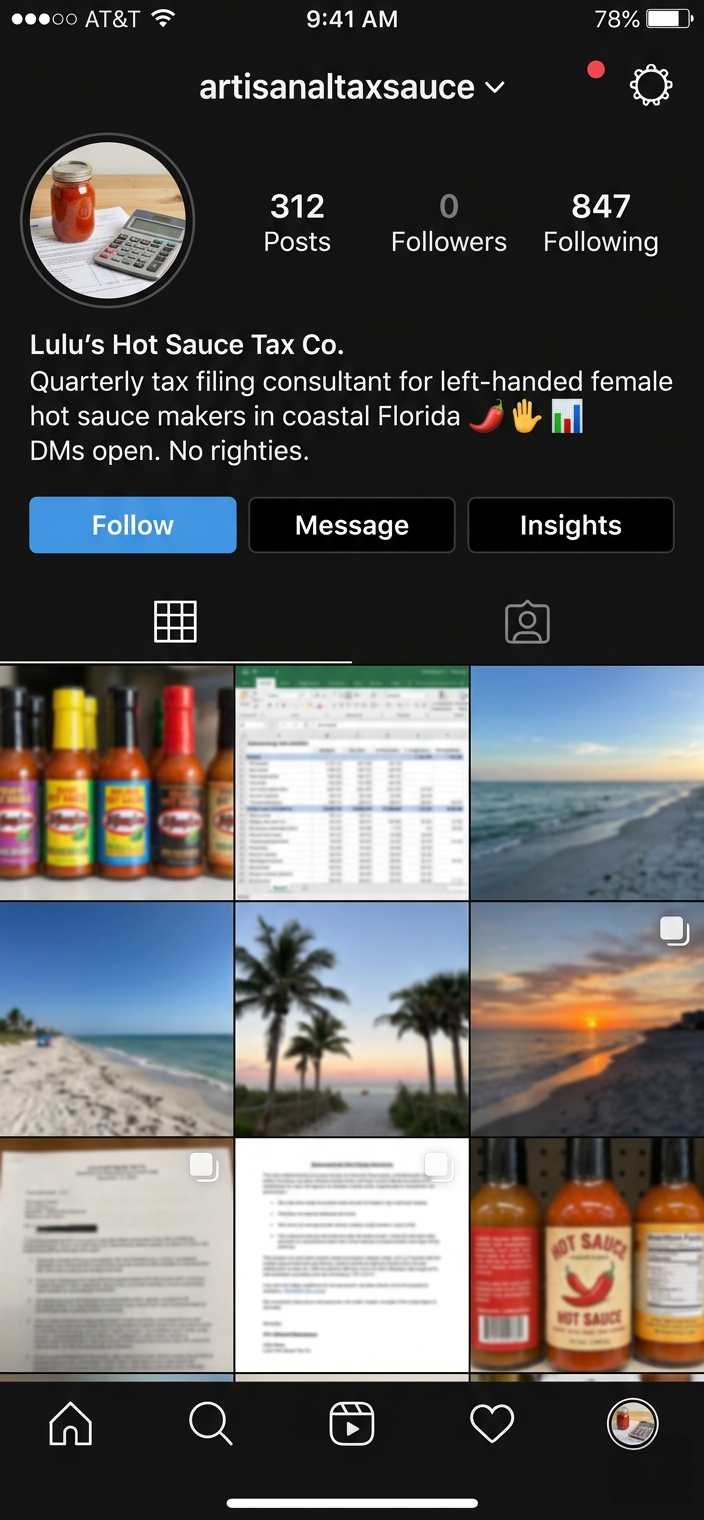
Everyone told you to niche down. Pick a lane and stay in it. Get specific and stop trying to talk to everyone. So you did. You got so specific that your entire brand now speaks to left-handed female entrepreneurs in coastal Florida who make artisanal hot sauce and need help with their quarterly tax filings. Congratulations. You have cornered a market of four people and two of them are your cousins. This post is about what happens when niching down stops being a strategy and starts being a personality disorder.
You're The Only One Who Finds It Interesting
There is a version of niching down that feels like genius from the inside and looks like a questionable disaster from the outside. The positioning seems airtight. The messaging is consistent. The visuals look immaculate. And yet there are six potential clients in the entire world who qualify. So instead of finding more clients, you write more content. Longer posts, deeper dives, more nuance, more explanation, because if you just explain it well enough surely someone will get it.
They won't.
You can be so specific that you're technically correct and practically invisible.
A niche that only you understand is not a niche, it's a concept.
Writing 4000 words about something three people care about is not content strategy, it's a journal.
If your ideal client has to be explained in four sentences, reconsider.
The most narrow niche in the world still needs an audience large enough to sustain a business.
One person who gets it (especially if that one person is you) is not a business model.
Read More → Defined By Default
The Content Gets Unhinged
This is where the chaos really starts. Because once the niche is too small to sustain itself, the content has to work harder. So it gets longer. More specific. More passionate. More convinced that the right angle is just around the corner. You're writing 1,500 word Instagram captions about the regulatory history of artisanal hot sauce labeling and tagging it #SmallBusiness. You have seventeen saves and fifteen of them are you checking to see if anyone saved it.
The content becomes a deeper and deeper explanation of something fewer and fewer people asked about.
Every post assumes a level of investment the audience never agreed to.
The passion is real but passion is not the same as relevance.
You start writing for the niche instead of for the person who has the problem.
At some point, the content stops being marketing and starts being a TED talk nobody signed up for.
This is usually the moment people think they need better content, but what they really need is better positioning. The Brand Blueprint is where that starts. It maps everything you need to know about what your content should be doing. When that exists, you stop writing into a void and start writing for people who are already looking for what you do. The content gets shorter, clearer, and more effective because it finally makes sense.
The Right Kind of Specific
The answer is not to go broad. Vague brands don't convert either. The difference is niching around the problem you solve instead of the identity of the person who has it. One is useful, the other is a personality quiz.
Niche around what you fix, not who you imagine fixing it for.
Get specific about your point of view, not your client's zip code and star sign.
Test it by asking if a stranger could understand your brand in one sentence.
The right niche makes people say "that's me" not "I wonder who that's for."
Broad enough to have an audience, specific enough to mean something.
When the positioning is right you don't have to work that hard. The right people find you, understand you, and don't need four paragraphs of context before they get it. That's what a niche is supposed to do, not narrow your audience into oblivion, but make the right audience feel like you're already talking to them.
Read More → The Right People
At Relative Media we help brands find the version of specific that actually works. Clear enough to attract the right people, but open enough to build a real business on. If your niche is starting to feel like a very niche problem, start with a Consult Deluxe and let's find the positioning that fits.
Read More
Customers Think. Fans Know.
Why does your brand feel personal to your audience? Learn how consistent brand strategy and clear visual identity turn customers into loyal fans.
Open The Brand Strategy Guide →
There’s a certain kind of audience that not only follows your brand, they claim it as theirs. They read into it, project onto it, and somehow feel like every decision was made with them in mind. To those people: thank you. Not because you’re always right (you’re not), but because your intensity reveals something important. When a brand is structured well enough, it becomes legible from multiple angles. It holds just enough specificity to feel intentional, and just enough openness to be interpreted. What looks like obsession is often just the byproduct of understanding.
That dynamic sits somewhere near the edge of what gets called parasocial. It describes the moment recognition becomes personal. When a body of work is consistent, it starts to feel familiar in a way that invites attachment. People see it and locate themselves inside it. Over time, that attachment turns into a kind of certainty: this is for me.
Remember: Customers think. Fans know.
At Relative Media, we build that level of recognition deliberately through the Brand Blueprint. This is where patterns are identified, defined, and organized into a system that can be repeated with precision. When the logic is this clear, people don’t hesitate, reinterpret, or second-guess what they’re seeing. They recognize it immediately, and that recognition is what creates the kind of attachment that feels personal, specific, and impossible to ignore*.
*This outcome, and its potential side effects, are addressed in Section 2 of our Terms of Service (Read Here).
Begin a project → Book a Consult Deluxe
Discover → The Brand Blueprint
Read More
Keeping Your Personal Brand Yours
Forming your own sphere creates a recognizable personal brand.
A personal brand means the person and the business are inseparable. You are more than a company; you are a human being in motion. Your work, your tone, your visuals, and your judgment are interpreted together. Today, that interpretation lives primarily on social media, where everything is visible and immediate. Your brand exists inside multiple spheres at once. Clients, peers, competitors, friends, and strangers are all viewing the same content from different angles. The same message has to hold up across very different expectations.
The Age of Constant Visibility
When spheres overlap, it’s easy to start watching yourself. You see what gets attention, you notice what’s rewarded, and you begin adjusting your message to match it. We call this phenomenon Stranger View: acting like an outsider to your own brand in order to predict what will work. But constantly trying to manage perception weakens your identity. The Brand Blueprint prevents that by clarifying your foundation first. It extracts the patterns already present in your work and organizes them so your decisions are defined, not momentary.
How a brand operating in Stranger View is perceived:
Uncertain
Unoriginal
Unnatural
Unclear
Uninspired
Read More → Defined By Default
It’s completely normal to borrow what seems to be working. When you see certain styles, phrases, or formats getting attention, it makes sense to lean in that direction. It means you’re paying attention. The problem is when copying becomes your default. Without a clear foundation, you start building around what’s popular instead of what’s yours. Over time, you look more like everyone else and less like yourself. Strong brands begin with definition. We focus on that first so everything else builds from something solid.
Personality by Design
Personality is what makes a personal brand compelling. Taking the time to define your values, your point of view, and your visual direction makes that personality easier to amplify. When those elements are clear, your identity doesn’t change depending on who is watching. Over time, people start associating you with specific qualities because those qualities show up consistently. In doing so, you form your own sphere. Your work feels connected, and the version of you that people see becomes unmistakable.
Why Choose a Personal Brand?
People connect with a person more easily than a company.
Your name carries your reputation.
Your personality becomes part of the work.
You can change and grow without losing who you are.
Your audience follows you*, not just your services.
What you stand for shows up naturally in what you create.
Over time, people recognize you for specific qualities.
Read More → Do Your Thing
The goal is to create an intentional sphere around yourself with a clear center and defined boundaries. When that structure is in place, you’re not guessing anymore. You know who you are, and other people can see it too. The Brand Blueprint extracts the patterns already present in your work and organizes them into a working system. It doesn’t change who you are. It makes what’s already there easier to build on, so your creativity has direction.
Forming Your Sphere vs. Choosing a Niche
Your personal sphere does not exist in isolation simply because it revolves around you. It still operates within a broader context, and today that context is largely social media. People naturally organize themselves around recognizable patterns and shared priorities. In business language, this is often described as choosing a niche. In our language, it’s an example of Intel Dynamics at work: intelligence organizing itself into structure.
How to create your own sphere*:
Identity comes first.
You decide who you are, not who you’re trying to target.Repetition comes next.
You keep coming back to the same ideas instead of reinventing yourself.Boundaries define the shape.
You’re clear about what fits in your sphere; you never stretch or shrink.Recognition builds from consistency.
When people see the same traits again and again, they start understanding you.The sphere forms.
All of that repetition and clarity start to feel cohesive. You finally make sense.A niche is what your sphere looks like from the outside.
Once your identity is clear and repeated, people naturally place it into a category.
Read More → Make It Make Sense
Over time, perception settles. When the same qualities appear again and again, people start to understand how to place you. They know what to expect. The right audience begins to orbit because the interpretation is clear. What others describe as a niche is simply the result of perception solidifying around a consistent identity. We help you define that identity clearly from the start, so the perception that forms around you is intentional.
At Relative Media, we believe a personal brand becomes recognizable when it’s consistent and clearly defined. On social platforms, it’s easy to follow whatever feels most visible in the moment. Without defining your perspective first, you end up mirroring what’s getting attention instead of building something lasting. The Brand Blueprint gathers what’s already present in your work and organizes it into something steady. With that foundation in place, your brand stays creative, cohesive, and recognizable as it grows.
Begin a project → Book a Consult Deluxe
Related guides
View the guide → The Brand Positioning Guide
Discover → The Brand Blueprint
Main Character Energy. No Plot.
When your brand constantly reacts to trends, it can start to look temporary.
Open The Brand Positioning Guide →
Nothing damages perception faster than looking temporary. When your brand redesigns itself every few months or mirrors whatever conversation is trending that week, it makes you look like you don’t know what you’re doing. Even if your visuals are on point, the lack of continuity is obvious. When something doesn’t feel grounded, it reads as short-lived. And when something feels short-lived, people hesitate to attach themselves to it. They don’t invest attention. They don’t commit. Disposable brands aren’t always low quality, they’re simply not built to last.
Social media complicates this because it is temporary by design. It moves quickly, rewards immediacy, and often requires real-time response. In a personal brand, where the business and the person are inseparable in perception, those shifts carry more weight. When tone, visuals, or messaging change constantly without a clear point of view behind them, people experience the Pause to Ponder: that moment of hesitation where they have to stop to figure out what they’re looking at. Your brand becomes something people have to work to make sense of instead of something they recognize.
At Relative Media, we build the Blueprint that allows your brand to stay current without looking chaotic. We don’t manage social media for personal brands because credibility can’t be outsourced. What we design instead is the structure behind your visibility: defined brand values, a clear perspective, and a cohesive visual identity rooted in who you already are. When that foundation is in place, you can respond to the moment without looking like you belong to it.
Begin a project → Book a Consult Deluxe
From the Relative Media Glossary
Short definitions, system terms, and working language.
See the full glossary here →
Defined By Default
If you don’t define your brand intentionally, it will be defined by default.
Your brand does not exist in theory, it exists in the minds of the people experiencing it. Every decision you make is interpreted by someone trying to understand who you are. People are meaning-making machines. They categorize, compare, and interpret instantly. Your brand is filtered through what they already know and what they expect before they ever read your about page. If you don’t define your brand intentionally, it will be defined by default. That is why human-centered design begins with understanding how people make sense of what they see.
You Don’t Exist in a Vacuum
When someone sees your brand, they don’t evaluate it on its own. They compare it to other brands they’ve seen before. If your website looks similar to five others in your industry, it will be understood that way. Comparison is automatic, and it shapes how you are interpreted. If you don’t define your context, this is what typically happens:
There’s no clear sense of what to expect from you.
It’s difficult to interpret what you’re doing.
People assume unintended things about you.
You’re reduced to a type, one of many similar options.
When your brand isn’t placed into a clear and intentional context, it is placed automatically based on whatever it most resembles. Assumptions settle in quickly because comparison is easier than explanation. Once that impression forms, it shapes how everything else is interpreted. From that point forward, every decision is filtered through a context you didn’t choose.
Read More → You Can’t Keep Surprising People
How to Position Your Brand Clearly
When you choose a niche, you’re deciding what your brand will be compared to and what it won’t. It’s easy to fall into familiar industry loops like following the same trends, using the same language, or shaping your work around what gets approval from others in your field. If you’re not deliberate, the focus can slowly shift away from the customer and toward fitting in. The group reinforces itself, expectations narrow, and what’s common starts to feel correct. When you follow what’s common, you get interpreted as common. A niche should clarify where you belong, not keep you circulating inside the same circle. This is what a niche does:
It clearly defines what kind of business you are and what category you belong to.
It determines who you’ll be compared to instead of leaving it up to chance.
It frames how your work is interpreted before you explain it.
It sets expectations about quality, price, and experience.
A niche isn’t restrictive when it’s chosen deliberately, and it doesn’t have to be narrow to be effective. A broad niche still defines the category you belong to without limiting the kind of work you can do. The goal isn’t to shrink your work, it’s to make your position clear enough that you’re understood accurately from the start.
Read More → Target Audience ≠ Target Identity
Context Is Strategy
When you pick a niche without thinking it through, you also pick up the assumptions that come with it. Every category carries expectations about price, quality, tone, and level of service. If you don’t decide what those expectations should be, they get assigned automatically. That’s why it’s important to consider your context and choose it deliberately. The Brand Blueprint sets the foundation for your brand, and the Perception Map helps to reveal how you’re currently being interpreted, exposing the assumptions you may be reinforcing without realizing it. Here’s what to be aware of when choosing your context:
Are you choosing a category, or just inheriting one?
Make sure you’re deciding what it means, not just adopting the label.
What assumptions come with this niche?
Every category implies a level, a tone, and a standard — whether you define them or not.
Are you building inside a closed loop?
If you’re only referencing others in your industry, you may be reinforcing patterns without questioning them.
Does your perception match your intention?
The Perception Map helps identify gaps between how you want to be understood and how you actually are.
Are your decisions aligned with your defined position?
Pricing, messaging, and visuals should reflect a deliberate context, not momentum.
The point of branding is to make sure you’re understood correctly. It’s what makes everything else work. When context is defined early, your decisions support each other instead of sending mixed messages. At Relative Media, that clarity is built into the Brand Blueprint before design ever begins.
Read More → The Right People
Your brand will always be interpreted in relation to something else. The only question is whether that relationship is chosen or inherited. Context determines how you’re compared, what assumptions attach to you, and how your decisions are read. When you define it intentionally, your brand becomes clear and consistent. When you don’t, interpretation happens anyway. Human-centered design begins with that reality. Branding is about deciding how you want to be understood, and making sure every decision supports that choice.
Related guides
View the guide → The Brand Positioning Guide
Discover → The Brand Blueprint
Target Audience ≠ Target Identity
Your market doesn’t need to be targeted, and your brand doesn’t need to mimic what’s already out there.
When brands start by imagining their target market, they end up shaping the whole thing around someone else’s expectations. Instead of uncovering what’s true, they edit their identity to fit who they think will respond. That kind of performance might look convincing, but people can tell when something’s just echoing what already exists. If your brand only works because it reminds people of something else, it’s never going to be the thing they actually remember. In this post, we’re examining why internal clarity comes before external appeal, what happens when you edit your brand too early, and how we help uncover something real enough to be remembered.
Don’t Edit Yourself for the Audit
Most brands pre-edit. They adjust their tone, tweak their visuals, and try to sound like what they think their audience wants before they’ve even figured out who they are. But branding works better when it starts unfiltered. Our Consult Deluxe is designed to bring that unedited version to the surface, while the Echo Check makes sure you’re not blending into the background. When a brand has structure and honesty at its core, it creates gravity. You don’t have to chase the right people, they already feel the pull. This is what editing before the audit does to your brand:
Covers up your real patterns
We can’t trace what you’ve already deleted.Makes you sound like everyone else
Borrowed tone = borrowed brand.Hides the parts worth building on
You cut what feels “off,” but that’s usually the best part.Gives us the version you think will sell
Which is never the version that creates the gravity you want.Tricks you into aiming too soon
You market before you understand what you’re working with.Blocks the people already trying to connect
Because they can’t recognize the thing you’re pretending not to be.Read More → The Right People
The Initial Upload is where we start tracing what’s already there. If you’re honest from the start, we can see the real ideas, avoid copycat territory, and map what’s already working. Once you fill out the Consult form, you’ll get a set of Brief Sheets to help you bring everything together so we can begin with what’s true, not what you think you’re supposed to show.
Understanding How People See Your Brand
We build brands to be recognized by real people, not personas. People who notice tone shifts, pattern breaks, and whether something’s been assembled or meticulously thought through. We treat the audience as intelligent observers, not passive targets. They don’t need to be told who you are. They’re already picking it up from what you’ve built. Here are some clues you’re a copy:
Too many borrowed phrases
Everything reads like a marketing template you found on someone else’s computer.Values that never show up in action
The words are there, but nothing backs them up.A logo and color palette with no real direction
It looks fine, but it could belong to any business, anywhere.Content that sounds like it’s trying to be a brand
Every sentence is optimized to perform, not to say anything that makes sense.A vibe you’ve seen a hundred times
It feels familiar, but not in a good way. You already know how it ends.Read More → Apples And Oranges
Your market doesn’t need to be targeted, and your brand doesn’t need to mimic what’s already out there. People can feel when something doesn’t come from a real place, even if they can’t explain why. Everyone notices, even if no one says it out loud. We’re here to help you uncover what’s true about your brand and build from that instead.
Coherence Creates Gravity
People notice when something makes sense, even if they don’t know why. That’s the function of brand strategy: when your visuals, tone, and behavior all line up, your brand feels instantly recognizable without needing a long explanation. This isn’t a trick or a trend. It’s the whole point of branding. This is what happens when your brand makes sense:
Your audience gets it, fast
People form impressions in seconds. When everything aligns, they don’t need to think twice about what you do or why it matters.You attract people who stay
When the message matches the visuals and the experience, people feel confident coming back.The right people recognize themselves in your brand
Instead of trying to “target” them, you’re speaking from a place they already understand.You stop trying to prove yourself
When your brand feels whole, people assume it’s legitimate and treat it that way.You become easier to talk about
A brand that makes sense is easier to remember, describe, and share. Your audience starts doing the marketing for you.
When your brand makes sense to people, they trust it faster and remember it longer. It’s easier for them to talk about, recommend, and get behind because they know what they’re getting. That kind of clarity makes everything look good and work better. Real growth starts when you stop pretending.
How to Build Without Copying
Notice what you like, and ask why
The goal is to understand your own taste so you’re not just reacting to trends.Check your Echo
Use the Echo Check to study what others in your market are doing so you can make sure you’re not blending in.Stay accountable to your own logic
Every brand move should point back to your system, not someone else’s momentum.Name what’s yours
Give language to your inspiration. The more specific your terms, the harder it is to copy someone else by accident.Hire a professional
If you want your brand to be more than just a collage of other people’s ideas, don’t do it alone. That’s what we’re here for.Read More → Is The Intelligence Behind Your Brand Artificial?
At Relative Media, we don’t separate who you are from how your brand works. We help you uncover the truth behind what you're making so you can grow with intent. When your brand starts with honesty, strategy gets clearer, design gets easier, and marketing feels less forced. That’s how the right people find you, and why they stay.
Related guides
View the guide → The Brand Strategy Guide
View the guide → The Brand Positioning Guide
Discover → The Brand Blueprint
Human-Centered Design: How Perception Shapes Positioning
In branding, chaos is just unorganized information.
When your brand is out in the world, it’s already being perceived. Long before someone understands what you do, they’re forming conclusions based on what they see, feel, and recognize. Perception doesn’t come from any single logo, post, or sentence. It comes from the total impression, the way everything interacts. That’s why our process begins with a full initial upload and the Echo Check, to understand both what your brand is already communicating and the context it’s communicating within. This guide covers how perception shapes positioning, why clarity starts with how your brand is being read, and how examining both gives you control over what to reinforce, what to correct, and what to clarify.
Why We Include a Perception Map in Your Brand Blueprint
In branding, chaos is just unorganized information. It lives in folders, half-finished ideas, things that don’t fit yet, and inspiration you haven’t organized. But chaos doesn’t stay internal for long. The moment a brand is visible, people start organizing what they’re seeing. They look for patterns. They connect the dots. They decide what kind of business you are, who it’s for, and whether it feels like something they want to be part of. Even if your brand feels completely scattered, it’s already being experienced as a whole.
This is Intel Dynamics at work. Intelligence naturally structures what it encounters. Meaning forms whether you guide it or not. We include a Perception Map with your Brand Blueprint because we don’t leave that process to chance. A Perception Map lets us see what your brand is communicating as a whole, so the conclusions people are already drawing don’t stay accidental. You gain awareness early, while your brand is still flexible, and you know what to reinforce, what to correct, and what to change before those impressions start shaping your story. A Perception Map allows you to:
• See how your brand is being organized in other people’s minds.
Learn how the humans are grouping what they see, what assumptions they’re likely making, and what story is forming without explanation.
Read More → Do Your Thing
• Identify mixed signals that weaken clarity and trust.
Figure out where visuals, language, offers, and behavior are sending different messages and forcing people to Pause To Ponder what they’re looking at.
• Surface unintended meanings and hidden strengths.
What your brand may be communicating without realizing it, and what it may already be doing well that can be reinforced.
• Understand how your brand values are being perceived.
Not the values you’d like to stand for, but the ones your brand behavior and presentation are currently expressing.
• Position from how your brand is being experienced.
So your positioning reflects what people are actually picking up from your brand.
Read More → Make It Make Sense
• Build the rest of your Brand Blueprint on something real.
Give your visual identity, messaging, and systems a foundation that reflects real perception, not imagined context.
We include a Perception Map in the Brand Blueprint to make perception visible. It lets you see how your brand is currently being experienced before you start shaping it. That context makes every decision that follows more effective.
Is There a Difference Between Perception and Reality?
There is always some distance between what a brand intends and what people experience. You know what you’re trying to build. They only know what they can see, feel, and interact with. The larger that gap gets, the more explanation your brand needs, and the more trust starts to rely on persuasion instead of recognition. This is why perception work is a core part of Consult Deluxe. We don’t treat perception as something to spin. We treat it as something to bring closer to the truth of what you’re actually offering. We focus on:
• Shrinking the gap between experience and intent.
What people pick up from your brand should reflect what you’re building.
• Aligning what your brand does with what it seems to be.
So your visuals, language, and behavior are pointing in the same direction.
Read More → Predictable Brands Win
• Removing the need for interpretation.
Your brand feels clear at a glance, without requiring explanation.
• Giving the Brand Blueprint a permanent foundation.
It’s built on how your brand is being experienced, not just what you hope it conveys.
There will always be a difference between what your brand is and how it’s perceived. The work is not to erase that difference, but to understand it and manage it. When the gap is small and intentional, your brand is easier to recognize and easier to position with confidence.
Why Perception Matters More Than Numbers
Marketing often treats people like data points, but brands are never experienced that way. People decide what something is, who it’s for, and whether it’s worth their attention long before any metric is recorded. The goal isn’t to be seen by everyone, but to be understood by the right people. Clarity creates preference, and some people won’t be interested, that’s part of how a brand stays clear. A perception-led brand allows you to:
• Create recognition before promotion.
People know what they’re looking at before you ever ask them to click, follow, or buy.
• Attract the right people without convincing everyone.
Clarity naturally pulls some people in and gives others a clear reason to move on.
Read More → The Right People
• Build preference, not just reach.
Your brand becomes something people choose, not just something they’ve seen.
• Make your marketing more effective.
Because it’s building on a brand people already understand.
Marketing doesn’t create perception. It spreads it. When perception is unclear, marketing only multiplies the problem. When it’s defined, even small efforts carry weight. That’s why we create a Perception Map for every client and build it into the Brand Blueprint so you’re starting from clarity instead of trying to fix things later.
What This Means for Your Brand
People understand what they’re looking at faster.
Your brand is easier to recognize and describe.
Fewer explanations are needed.
The right people feel a clearer pull.
Marketing has something solid to amplify.
You can make corrections early, while your brand is still flexible.
Your brand presents as more credible and considered.
Frequently Asked Questions
Q: What is a Perception Map?
A: A Perception Map is how we look at how your brand is currently being experienced. It examines the patterns across your visuals, language, and behavior to understand what people are likely concluding when they encounter your brand. It doesn’t measure what you intend. It reveals what’s actually being communicated.
Q: How is perception different from positioning?
A: Perception is how people are already reading your brand. Positioning is the set of decisions you make once you understand that reading. Without perception work, positioning is just a guess.
Q: Why does perception matter if my business is still new?
A: Perception starts forming the moment something becomes visible. Even early brands are being categorized, compared, and interpreted. Working with perception early lets you correct course while your brand is still flexible, instead of having to undo expectations later.
At Relative Media, we use perception work to ground your Brand Blueprint in reality. After the initial upload, the Echo Check, and values work, we build a Perception Map to see how your brand is being experienced before major decisions are made. That clarity is what turns positioning into a practical step instead of a guessing game, and gives everything that follows (visual identity, messaging, and marketing) a clear point of reference.
Further Reading
→ IDEO, Human-Centered Design
→ Water Logic by Edward de Bono
→ The Laws of Human Nature by Robert Greene
Related guides
View the guide → The Branding Services Guide
View the guide → The Strategic Design Guide
You Can’t Keep Surprising People
One of the strangest things about being a creative is that everyone assumes you’re doing it on purpose.
Open The Brand Strategy Guide →
One of the strangest things about being a creative is that everyone assumes you’re doing it on purpose. Every post, every visual, every weird little choice, they think it’s all deeply intentional. But half the time you're just trying things and hoping people "get it." And when they don’t, it’s easy to chalk it up to being ahead of your time.
The problem isn’t your work. It’s the fact that you haven’t given anyone a reliable way to understand what you’re doing. A logo won’t fix that. A cool typeface won’t fix that. What actually helps is having a clear position, something that ties all your experiments together. So when someone lands on your page, they don’t have to play a guessing game. They just get it.
At Relative Media, we help creatives stop reinventing themselves every time they launch a new idea. We define the through-line, build the structure, and give your work a consistent shape so people can recognize your style without needing to decode it. You still get to be unpredictable. You just don’t have to be a mystery.
Begin a project → Book a Consult Deluxe
Do Your Thing
If your branding doesn’t help people understand you faster or choose you with more confidence, then what’s it doing?
Open The Simple Branding Guide →
Open The Brand Positioning Guide →
Your logo is clean. Your colors are on-trend. Your Instagram grid looks like you gave it some thought. People are noticing. They’re complimenting. You’re getting little hits of validation every time you post, and that’s nice. But once the aesthetic honeymoon wears off, you’re still left with one question: Does any of this actually work? Your whole feed is selfies, and every caption is “this was so fun,” but what’s actually holding it all together?
Good branding isn’t just visual, it’s functional too. If your branding doesn’t help people understand you faster or choose you with more confidence, then what’s it doing? That’s where a perception map comes in. It charts how your materials are currently read, and compares that to how you want to be seen. It’s a map that connects the compliments you’re getting to the strategy you actually need. No more guessing. No more redesigning your pitch deck at midnight because “something feels off.” You’ll know what’s working, what’s missing, and where perception is quietly undermining your message.
At Relative Media, we make brands that look good and work even better. Every Brand Blueprint defines your brand values, charts your perception goals, establishes a moodboard-style brand sheet, and identifies your content pillars, so your visuals and messaging are perfectly aligned. Because yes, you deserve compliments. But you also deserve a brand that earns them over and over again, not just on launch day. One that holds up, holds together, and keeps making sense no matter how many trends pass by.
Begin a project → Book a Consult Deluxe
Discover → The Brand Blueprint
The Right People
We use the latest cross-disciplinary studies in aesthetic cognition to help you make something you like, and then make sure the right people find themselves in it.
Open The Brand Positioning Guide →
Sometimes you make something because you like it. Like a ceramic orb, or a shirt with the haunted-looking fish, or a neon menu board that felt right. And somehow, people got it. They bought it. They shared it. They even assigned it meaning you never intended. This isn’t luck. It’s something scientists are now calling emergent aesthetic cohesion, and yes, it’s real.
Right now, brand theorists are studying the uncanny way products that start from authentic expression seem to magnetize a specific audience even when they weren’t “aimed” at anyone. Turns out, the humans are extremely good at recognizing unspoken systems. When your product is internally consistent, even if it’s just a weird vibe, an odd mascot, or a recurring color, people start to form their own interpretations. It’s what makes brands grow without needing a whiteboard full of fake taglines and speculative moodboards about “millennial synergy.”
At Relative Media, we build brands the same way researchers study mushrooms: by tracing the hidden networks. We use the latest cross-disciplinary studies in aesthetic cognition, emergent audience behavior, and brand semiotics to help you make something you like, and then make sure the right people find themselves in it. We don’t chase trends. We chase internal logic, linguistic cohesion, and that strange, magnetic feeling that happens when something just feels “right.” Your audience will find you. We’ll make sure there’s something worth finding.
Begin a project → Book a Consult Deluxe
Keep Reading
Take Another Stab at It: Predictable Brands Win
We build brands with the kind of predictable structure that gives you freedom everywhere else.
Open The Brand Positioning Guide →
There’s value in not being predictable when you’re a person. In life, unpredictability keeps you interesting. It’s what lets you take a different street home, change careers at thirty-seven, or surprise yourself with a decision you didn’t see coming. Being unpredictable creates momentum. It keeps you out of the rut, forces you to think, and makes sure you’re actually steering your own life.
But in branding, predictability is the entire point. A brand without a predictable structure loses trust, clarity, and direction. People need to know what they’re going to get from you, visually, verbally, and emotionally. Predictability in branding is stabilizing, not boring. It’s the reason strong visual identity systems work, the reason brand logic matters, and the reason simple branding is more effective than a constantly changing aesthetic. Consistency is what builds recognition, reduces decision fatigue, and helps customers understand who you are within seconds.
At Relative Media, we build brands with the kind of predictable structure that gives you freedom everywhere else. Our work blends brand logic, visual identity design, and strategic clarity so your audience never has to guess what you stand for. If someone is searching for branding help, simple branding, logo design, brand identity design, or a graphic designer in Florida, they’re looking for exactly what we do, and we make sure your brand is ready to be found, recognized, and remembered.
Begin a project → Book a Consult Deluxe
Make It Make Sense
When your brand is clear, people take you seriously.
Open The Brand Positioning Guide →
Open The Brand Strategy Guide →
Most people aren’t really looking that hard. They’re scanning, skimming, scrolling, and making up their minds in half a second. If your brand looks like it doesn’t know what it’s doing, they’ll assume the same about your services. Most won’t tell you what they think. They’ll just move on.
A cohesive brand tells people (without saying a word) that you’re competent, consistent, and worth the investment. A strong brand system is the fastest way to shift how you're being seen. When everything lines up, people believe the story. They know what you’re about. And they trust that you’ll deliver.
None of this has to do with your actual skills. It’s about the feeling your brand gives off. And if your brand gives off uncertainty, your business tends to suffer. A cohesive brand sends an entirely different message. It says:
You’ve done the work to figure out who you are
You make clear decisions
You know how to communicate
You’re reliable, consistent, and worth the investment
At Relative Media, we build brands people can understand without a second guess. Through our Consult Deluxe, we help you define how you want to be seen, then we create a Brand Blueprint that holds everything together: your voice, your visuals, and the logic behind both. When your brand is clear, people take you seriously. That’s what makes it work.
Begin a project → Book a Consult Deluxe