
All writing.
Browse by Theme
Starting Something New
Being first means inventing a category nobody else is playing in.
Open The Brand Strategy Guide →
Every sport had a first day. Someone invented a rule and did the thing before anyone alive had done it. The people who show up centuries later, the ones who look like they were built for the game, end up better at it than the person who made it up. Which raises a strange question for anyone building something. If going first leaves you worse at it than everyone who follows, why does it still matter more than being good?
The First Version of Anything Will Probably Suck
The man who invented basketball nailed a peach basket to a railing and never thought to cut a hole in the bottom. Every time someone scored, play stopped so a person could climb a ladder and fish the ball back out. The first version of the game was slow, awkward, and missing the parts that now look obvious. This is true of nearly everything that gets invented. The original is crude because the person making it had nothing to copy and no standard to chase.
James Naismith, who invented basketball in 1891, is the only coach in the University of Kansas program's history to finish with a losing record.
The runner at the center of the marathon legend, Pheidippides, reportedly collapsed and died the moment he finished, which is a strange origin story for an event people now train years for.
In early chess, the piece where the queen now stands could move only one square at a time, making it seem like one of the weakest pieces on the board. Today, it’s the most powerful piece in the game.
The inventors mattered anyway. The peach basket is the only reason there is a game to be good at. Every refinement that followed, the open net, the shot clock, the three-point line, was a correction applied to something that already had a shape. The first version looks clumsy because it is doing the hardest thing there is, which is going from nothing to something. Skill can only show up once that part is done.
Read More → Give Us Everything You’ve Got
Make It Look Natural
Nobody is born good at basketball. You're born with physical traits that the game happens to reward. A child who looks made for basketball was not designed by the universe to play a sport a gym teacher invented in 1891, they were born tall, or quick, or unusually good at tracking a moving object through space, and the game happened to reward exactly that. The talent feels natural because the structure was built, slowly and by many hands, to sit neatly on top of traits people already had. We see the fit and call it a gift.
A sport gets quietly reverse-engineered over time to reward whatever keeps winning, which is part of why the average height in professional basketball climbed for decades as the game matured.
The swimmers we call naturals tend to share measurable physical traits that no amount of training can install.
Left-handed athletes are overrepresented in sports with a direct opponent, like fencing, boxing, and baseball pitching, because their rarity is a structural edge that has nothing to do with effort.
This matters for brands too. The ones that feel inevitable are not lucky. They are built intentionally around what the founder is actually good at. You make choices about who you serve, what you say, and how you work, based on what comes naturally to you. When your structure matches your instincts, the fit looks like destiny.
Read More → Keep It You
Playing Someone Else's Game
Most small businesses are trying to be the best at something that already has a leader. The better coffee shop, the better consultant, the better studio. They take an existing category, study how the strongest player does it and try to do the same thing, but better. People can tell the difference between an original and a copy, no matter how polished the copy becomes. They can sense when something was invented versus when it was made to compete.
Your category can be tiny, a single intersection of two things nobody has combined before, and it still makes you the original instead of the imitation.
Being first does not require inventing a service nobody offers, it can mean being first to do a familiar one for a specific kind of person, in a specific place, with a specific point of view.
The roughness of an early version works in your favor here, because a brand that is first to something looks a little strange before it looks obvious, and sometimes strange is what people remember.
The first version of anything carries weight that refinement alone never produces. It resists change because it holds a shape that did not exist before it arrived. That is why the original tends to endure even after later versions get technically better. Everything afterward is quietly built on top of it, even when the copies are smoother, faster, or more polished. The structure came first, and the structure is what matters most.
Read More → Do Your Thing
At Relative Media, we start with your foundation because the best part of your business is the thing only you could have built. Everyone has something like that to offer. The hard part is finding it, and that's what the Brand Blueprint is for. When what you build finally matches who you are, you stop competing with everyone else and end up in a league of your own.
Begin a project → Book a Consult Deluxe
Discover → The Brand Blueprint
Relative Momentum: When Your Brand Forms A Life Of Its Own
Every brand eventually starts moving on its own. Here is how that momentum builds, why it feels strange when the brand is you, and how a clear foundation helps keep it yours.
Every brand reaches a point where it starts running on its own. Your work looks great without as much thought. You take a week off and nothing falls apart. Your brand finally has enough behind it to keep going without you having to push so hard. We call this Relative Momentum. It is what all that consistency was building toward, even when none of it felt like much at the time. The small push that first launches a brand and the current that later carries it are two different forces, and almost no one separates them. Sometimes watching it move on its own can feel unsettling, no matter what the brand is. When the brand is you, it can be stranger still.
How It Builds
For a long time, you are the one responsible for moving your brand forward. Every piece you put out, every conversation with a client, every design choice either fits the pattern or goes wildly off-brand. If all goes well, at some point, your brand keeps moving without you. We cannot tell you when that point will be. The timing has nothing to do with how many posts you have made or how long you have been in business, and it rarely lands on the day you would expect. More often, it shows up after something that felt completely unremarkable at the time. You catch it afterward, through a side effect: a referral from a stranger, your own words quoted back to you, the quiet realization that you are explaining yourself less and being understood more. By the time you can see it, it has already been true for a while. It is the whole accumulation finally reaching a weight that no one could have measured along the way.
Showing up consistently matters more than posting a lot.
The buildup isn’t tangible, so you rarely notice it happening.
Repeating one clear idea works better than introducing many new ones.
Brands with a clear foundation reach this point faster and need less fixing later.
This is Intel Dynamics at work. Clear, repeated input slowly turns into structure, and at some point, structured things start to function on their own. The patterns that make a brand recognizable only show up after enough real decisions to prove them, so most brands have to Give It A Second before the real thing reveals itself. You cannot claim it early or force it forward. What we can do is help you build on something solid from the start, so the momentum that forms is carrying the right thing. That is what the Brand Blueprint is for.
Existing On Its Own
For a company, the brand outgrowing any one person is the goal. For a personal brand, it feels different because you are the brand. Suddenly, people are talking about you and forming opinions, all from a small piece of what you have put out. They do it in rooms you are not in, and they do it while you are sitting right there, describing your work to each other like they are talking about someone else. You are still the source of it, but you are no longer steering every moment. Most people feel this as a loss of control, a version of them out in the world that anyone can shape but them.
Your name comes up in conversations you are not part of.
Something you posted months ago is still bringing people in.
Someone explains your work to a stranger and mostly gets it right.
People come out of the woodwork already knowing what you do.
Others repeat what you stand for and start doing it too.
You made something to represent you, and now it represents you without asking first. You cannot control how it gets read once it is moving, and fighting that only wears you down. What you can control is what you built into it, and that is the part out there doing the work.Keeping Your Personal Brand Yours is where that work starts.
It Gets Easier
At the start, everything you make begins from zero. You explain who you are, you build everything from scratch, and the return rarely matches the effort. Once your brand has momentum, that ratio inverts. Every new piece lands on top of everything that came before it, so it carries further than the last one did. Recognition compounds the same way, because each person who already gets it tends to bring the next one along. You are still doing the work. It just returns far more than it used to.
The grind early on does not predict the payoff later, the two phases are nothing alike.
Old work keeps earning, a piece from a year ago still brings people in and now carries the weight of everything made since.
New work inherits trust it never had to earn.
Referrals start generating referrals, since every new person who finds you is a potential source of the next.
This is what makes the early grind worth it. A brand built on something consistent appreciates, meaning the work you did last year keeps paying off while everything new compounds on top of it. This is also the long game behind What Makes A Simple Brand Work. Everything accumulates, and then it starts working on its own behalf. Brands that reach this point are the ones that stayed consistent long enough for the compounding to begin.
At Relative Media we do not deal in hypotheses, and we are not here to sell you a theory. Both of those come later, after a lot of guessing and testing. We work one step before either of them. We point out what happens every single time, no matter the industry or the size of the business. Relative Momentum is one of those things. The Brand Blueprint is where we capture these patterns for your brand, and the Consult Deluxe is where we point them out to you directly, early enough that you still get to choose the direction.
Begin a project → Book a Consult Deluxe
Discover → The Brand Blueprint
View the Relative Media Glossary
Short definitions, system terms, and working language.
See the full glossary here →
Read More
Niching Down Too Hard
Most small businesses get so specific with their branding that they accidentally build an audience of one. Learn how brand strategy helps you find the positioning that attracts real clients.
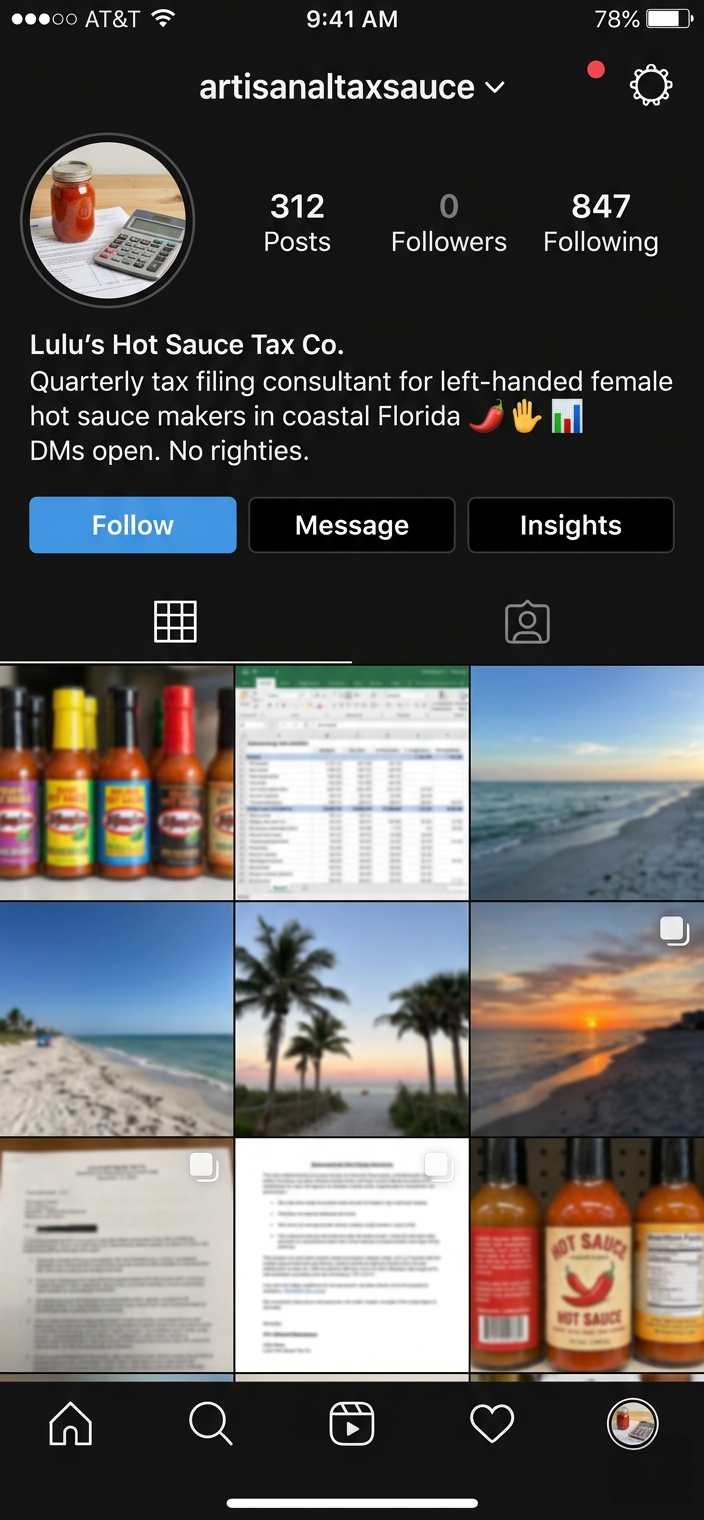
Everyone told you to niche down. Pick a lane and stay in it. Get specific and stop trying to talk to everyone. So you did. You got so specific that your entire brand now speaks to left-handed female entrepreneurs in coastal Florida who make artisanal hot sauce and need help with their quarterly tax filings. Congratulations. You have cornered a market of four people and two of them are your cousins. This post is about what happens when niching down stops being a strategy and starts being a personality disorder.
You're The Only One Who Finds It Interesting
There is a version of niching down that feels like genius from the inside and looks like a questionable disaster from the outside. The positioning seems airtight. The messaging is consistent. The visuals look immaculate. And yet there are six potential clients in the entire world who qualify. So instead of finding more clients, you write more content. Longer posts, deeper dives, more nuance, more explanation, because if you just explain it well enough surely someone will get it.
They won't.
You can be so specific that you're technically correct and practically invisible.
A niche that only you understand is not a niche, it's a concept.
Writing 4000 words about something three people care about is not content strategy, it's a journal.
If your ideal client has to be explained in four sentences, reconsider.
The most narrow niche in the world still needs an audience large enough to sustain a business.
One person who gets it (especially if that one person is you) is not a business model.
Read More → Defined By Default
The Content Gets Unhinged
This is where the chaos really starts. Because once the niche is too small to sustain itself, the content has to work harder. So it gets longer. More specific. More passionate. More convinced that the right angle is just around the corner. You're writing 1,500 word Instagram captions about the regulatory history of artisanal hot sauce labeling and tagging it #SmallBusiness. You have seventeen saves and fifteen of them are you checking to see if anyone saved it.
The content becomes a deeper and deeper explanation of something fewer and fewer people asked about.
Every post assumes a level of investment the audience never agreed to.
The passion is real but passion is not the same as relevance.
You start writing for the niche instead of for the person who has the problem.
At some point, the content stops being marketing and starts being a TED talk nobody signed up for.
This is usually the moment people think they need better content, but what they really need is better positioning. The Brand Blueprint is where that starts. It maps everything you need to know about what your content should be doing. When that exists, you stop writing into a void and start writing for people who are already looking for what you do. The content gets shorter, clearer, and more effective because it finally makes sense.
The Right Kind of Specific
The answer is not to go broad. Vague brands don't convert either. The difference is niching around the problem you solve instead of the identity of the person who has it. One is useful, the other is a personality quiz.
Niche around what you fix, not who you imagine fixing it for.
Get specific about your point of view, not your client's zip code and star sign.
Test it by asking if a stranger could understand your brand in one sentence.
The right niche makes people say "that's me" not "I wonder who that's for."
Broad enough to have an audience, specific enough to mean something.
When the positioning is right you don't have to work that hard. The right people find you, understand you, and don't need four paragraphs of context before they get it. That's what a niche is supposed to do, not narrow your audience into oblivion, but make the right audience feel like you're already talking to them.
Read More → The Right People
At Relative Media we help brands find the version of specific that actually works. Clear enough to attract the right people, but open enough to build a real business on. If your niche is starting to feel like a very niche problem, start with a Consult Deluxe and let's find the positioning that fits.
Read More
What Your Brand Shouldn’t Have to Say
Most brands say too much. This guide breaks down what needs to be said, what should be implied, and how to create clearer, stronger branding.
Adjectives, explanations, and clarifications have a way of piling up. What begins as an attempt to be clear about your brand turns into an effort to control every conclusion instead of letting one form on its own. That’s when your brand starts saying things the audience should already be able to pick up on their own, and things start to feel off. In this post, we break down where that line is and what happens when you ignore it.
What Adjectives Reveal
Adjectives are usually treated like a finishing touch, but most of the time, they’re doing something else entirely. Words like “premium,” “authentic,” “passionate,” and “cutting-edge” aren’t adding meaning, they’re trying to create it. The moment you feel the need to say “high-end,” something has already suggested that it isn’t. If the materials, typography, layout, and execution were aligned, that conclusion would form on its own. Instead, you’re using words to do the work your branding should have handled. There’s an insistence behind it, like it’s trying to guide you toward a specific reaction instead of letting you arrive there, and that shift is small but noticeable enough to introduce doubt. Here’s what to do:
Remove the adjective and see if the idea stays the same.
Replace descriptive words with visible decisions (materials, layout, typography, process).
Only state what cannot be shown through the work itself.
Aim for conclusions the audience reaches on their own, not ones you direct.
When You Say It Anyway
This doesn’t stop at adjectives. It shows up in the sentences that sound good but don’t actually do anything, like: “we focus on results,” “we value new ideas,” “our process is simple.” They don’t clarify your brand, they just repeat what should already be apparent. When your brand is doing its job, those conclusions are already forming through how everything is put together. When they’re written out anyway, the copy starts to look suspicious. The reader isn’t gaining meaning, they’re being told something they’ve already picked up on, and that repetition creates doubt. Instead of reinforcing your brand, the words interrupt it, and this is where the Pause to Ponder shows up in a different way, not as confusion, but as a reason to move on. Here’s what to leave out:
Cut any sentence that repeats the obvious.
Keep only what adds new, necessary information.
If you feel the need to explain it, check what isn’t supporting it.
Replace broad statements with something specific or observable.
Let your brand carry meaning so the copy doesn’t have to.
Letting It Land
The shift is about letting your brand carry meaning so the copy doesn’t have to, not just saying less for the sake of it. When everything is aligned, the message doesn’t need to describe itself, it’s already being understood. A brand that is clear in how it presents, speaks, and operates creates its own conclusions. “Simple” shows up in restraint. “Expert” shows up in direct, unembellished language. “Premium” shows up in precision and consistency. Nothing has to be labeled because nothing is unclear. The visuals hold their position, the tone stays controlled, and the writing doesn’t step in to over-explain. You don’t have to remove language entirely, but it’s important to know exactly what it’s responsible for. When that line is clear, perception stabilizes. People don’t need to be told what to think, they arrive there on their own. What carries meaning:
Consistency across everything, not isolated claims.
Precision instead of broad descriptors.
Restraint in what is said and what is left out.
Direct language that doesn’t try to impress.
Copy that supports your brand instead of summarizing it.
The fastest way to weaken a brand is to explain it too much. Every extra word that tries to guide the audience toward a conclusion does the opposite, it makes them question why the conclusion wasn’t obvious to begin with. A strong brand doesn’t need to describe what it is. It presents enough evidence that the right impression forms without assistance.
At Relative Media, we focus on building that structure first so your brand doesn’t have to rely on explanation to be understood. That’s the role of the Brand Blueprint, it sets the logic in advance so your message stays clear, and the perception that follows is exactly what you intended.
Begin a project → Book a Consult Deluxe
Discover → The Brand Blueprint
From the Relative Media Glossary
Short definitions, system terms, and working language.
See the full glossary here →
Keeping Your Personal Brand Yours
Forming your own sphere creates a recognizable personal brand.
A personal brand means the person and the business are inseparable. You are more than a company; you are a human being in motion. Your work, your tone, your visuals, and your judgment are interpreted together. Today, that interpretation lives primarily on social media, where everything is visible and immediate. Your brand exists inside multiple spheres at once. Clients, peers, competitors, friends, and strangers are all viewing the same content from different angles. The same message has to hold up across very different expectations.
The Age of Constant Visibility
When spheres overlap, it’s easy to start watching yourself. You see what gets attention, you notice what’s rewarded, and you begin adjusting your message to match it. We call this phenomenon Stranger View: acting like an outsider to your own brand in order to predict what will work. But constantly trying to manage perception weakens your identity. The Brand Blueprint prevents that by clarifying your foundation first. It extracts the patterns already present in your work and organizes them so your decisions are defined, not momentary.
How a brand operating in Stranger View is perceived:
Uncertain
Unoriginal
Unnatural
Unclear
Uninspired
Read More → Defined By Default
It’s completely normal to borrow what seems to be working. When you see certain styles, phrases, or formats getting attention, it makes sense to lean in that direction. It means you’re paying attention. The problem is when copying becomes your default. Without a clear foundation, you start building around what’s popular instead of what’s yours. Over time, you look more like everyone else and less like yourself. Strong brands begin with definition. We focus on that first so everything else builds from something solid.
Personality by Design
Personality is what makes a personal brand compelling. Taking the time to define your values, your point of view, and your visual direction makes that personality easier to amplify. When those elements are clear, your identity doesn’t change depending on who is watching. Over time, people start associating you with specific qualities because those qualities show up consistently. In doing so, you form your own sphere. Your work feels connected, and the version of you that people see becomes unmistakable.
Why Choose a Personal Brand?
People connect with a person more easily than a company.
Your name carries your reputation.
Your personality becomes part of the work.
You can change and grow without losing who you are.
Your audience follows you*, not just your services.
What you stand for shows up naturally in what you create.
Over time, people recognize you for specific qualities.
Read More → Do Your Thing
The goal is to create an intentional sphere around yourself with a clear center and defined boundaries. When that structure is in place, you’re not guessing anymore. You know who you are, and other people can see it too. The Brand Blueprint extracts the patterns already present in your work and organizes them into a working system. It doesn’t change who you are. It makes what’s already there easier to build on, so your creativity has direction.
Forming Your Sphere vs. Choosing a Niche
Your personal sphere does not exist in isolation simply because it revolves around you. It still operates within a broader context, and today that context is largely social media. People naturally organize themselves around recognizable patterns and shared priorities. In business language, this is often described as choosing a niche. In our language, it’s an example of Intel Dynamics at work: intelligence organizing itself into structure.
How to create your own sphere*:
Identity comes first.
You decide who you are, not who you’re trying to target.Repetition comes next.
You keep coming back to the same ideas instead of reinventing yourself.Boundaries define the shape.
You’re clear about what fits in your sphere; you never stretch or shrink.Recognition builds from consistency.
When people see the same traits again and again, they start understanding you.The sphere forms.
All of that repetition and clarity start to feel cohesive. You finally make sense.A niche is what your sphere looks like from the outside.
Once your identity is clear and repeated, people naturally place it into a category.
Read More → Make It Make Sense
Over time, perception settles. When the same qualities appear again and again, people start to understand how to place you. They know what to expect. The right audience begins to orbit because the interpretation is clear. What others describe as a niche is simply the result of perception solidifying around a consistent identity. We help you define that identity clearly from the start, so the perception that forms around you is intentional.
At Relative Media, we believe a personal brand becomes recognizable when it’s consistent and clearly defined. On social platforms, it’s easy to follow whatever feels most visible in the moment. Without defining your perspective first, you end up mirroring what’s getting attention instead of building something lasting. The Brand Blueprint gathers what’s already present in your work and organizes it into something steady. With that foundation in place, your brand stays creative, cohesive, and recognizable as it grows.
Begin a project → Book a Consult Deluxe
Related guides
View the guide → The Brand Positioning Guide
Discover → The Brand Blueprint
Main Character Energy. No Plot.
When your brand constantly reacts to trends, it can start to look temporary.
Open The Brand Positioning Guide →
Nothing damages perception faster than looking temporary. When your brand redesigns itself every few months or mirrors whatever conversation is trending that week, it makes you look like you don’t know what you’re doing. Even if your visuals are on point, the lack of continuity is obvious. When something doesn’t feel grounded, it reads as short-lived. And when something feels short-lived, people hesitate to attach themselves to it. They don’t invest attention. They don’t commit. Disposable brands aren’t always low quality, they’re simply not built to last.
Social media complicates this because it is temporary by design. It moves quickly, rewards immediacy, and often requires real-time response. In a personal brand, where the business and the person are inseparable in perception, those shifts carry more weight. When tone, visuals, or messaging change constantly without a clear point of view behind them, people experience the Pause to Ponder: that moment of hesitation where they have to stop to figure out what they’re looking at. Your brand becomes something people have to work to make sense of instead of something they recognize.
At Relative Media, we build the Blueprint that allows your brand to stay current without looking chaotic. We don’t manage social media for personal brands because credibility can’t be outsourced. What we design instead is the structure behind your visibility: defined brand values, a clear perspective, and a cohesive visual identity rooted in who you already are. When that foundation is in place, you can respond to the moment without looking like you belong to it.
Begin a project → Book a Consult Deluxe
From the Relative Media Glossary
Short definitions, system terms, and working language.
See the full glossary here →
The Reverb Effect: What Comes Back to Your Brand
The Reverb Effect explains how the things your brand consistently shows shape perception over time, and how they come back as reputation and recognition.
Everything your brand puts into the world travels through memory, conversation, and association. It comes back as reputation, expectation, and recognition. Most businesses experience this as a surprise: the kinds of people who reach out, the assumptions made before anything is explained, the way a conversation starts before you have said a word. None of that is random.
This is what we call the Reverb Effect. It is the idea that brand output does not end at the point of contact. Every signal your brand sends is contributing to a perception that is already forming, whether you designed it intentionally or not. The effect is cumulative and operates with a delay, meaning what you put out now shapes how you are received months later. By the time most brands notice the return signal, it has been building for a while.
The best way to work with the Reverb Effect is to understand it clearly first. When you start asking how people actually describe you, what they expect before you speak, and how they group your brand relative to others, patterns start to appear that you did not put there intentionally. Those patterns are not random, they are the accumulation of repeated decisions. The unintentional ones are often the most powerful because they are usually the most honest and have been operating without correction. Understanding this changes how you think about your brand. The question stops being "does this look good" and starts being "what is this teaching people to expect from us?"
At Relative Media, we use the Reverb Effect to understand what your brand is already putting out and what it is getting back. The Perception Map (one of the core deliverables in the Brand Blueprint) is how that work gets done. It shows you what is already in motion, and where it’s landing. A Consult Deluxe session is where that work starts.
Begin a project →Book a Consult Deluxe
Discover → The Brand Blueprint
From the Relative Media Glossary
Short definitions, system terms, and working language.
See the full glossary here →
Read More
Rebrand With Intention
If your business has evolved but your identity hasn’t, it may be time to rebrand. Learn how to rebuild with structure using our Brand Blueprint.
Open The Brand Blueprint Guide →
When you first launched, your brand made sense. It reflected where you were, what you were offering, and the kind of work you wanted to be known for. But businesses change, and the positioning that once felt sharp has a way of becoming something you quietly outgrow. The services evolve, the audience shifts, the tone that used to feel right starts to feel like a costume. A rebrand is not about starting over from scratch. It is about correcting the structure so your business can move forward without dragging an old identity behind it.
The Most Common Signs You Are Ready
Most people know something is off before they can name it. The brand still exists, the logo is still there, but something about it stopped feeling true a while ago. It shows up in small ways at first, a hesitation before sending someone to your website, a pitch that takes longer to explain than it should, a visual identity that no longer matches the quality of work you are actually doing. You might find yourself explaining what you do not do more than what you do. Or you have updated things on your own a few times, and it still does not feel right. Over time, those small things accumulate into a real problem, and the brand that was supposed to help you starts working against you instead.
Your messaging feels vague, dull, or harder to explain than it should.
People still associate you with services you no longer offer.
Your audience has changed but your visuals and tone have not.
The brand feels like a record of who you were rather than a signal of where you are going.
You have been avoiding updating your website because you are not sure what to say anymore.
A rebrand helps you realign so your message, visuals, and values all reflect what your business is doing now. It is also a chance to let go of old rules that stopped making sense, retire the parts of the brand that were always a compromise, and rebuild from something that actually fits. The goal is not just to look better. The goal is to make it all feel right again because it is built on something true, not on who you were two years ago when you were figuring it out.
What a Rebrand Fixes
A rebrand is not a visual refresh, and treating it like one is the most common mistake people make when they go through the process. Changing the colors or updating the logo without touching the underlying logic produces the same brand with a new coat of paint. Six months later everything feels off again because the structure was never addressed. What actually needs to change are the decisions about how you are positioned, what you stand for, and how everything you put out communicates that. The Brand Blueprint addresses exactly this, it is a strategic document that defines how your brand is perceived, expressed, and experienced, and it is the foundation that every visual and messaging decision builds from. Without it, a rebrand is just a redesign.
A repositioned brand attracts work that fits where you are now, not where you started.
Clarifying your values in writing makes every creative decision faster and more consistent.
A perception map shows you where the gap is between how you are currently seen and how you want to be seen.
Content pillars give your messaging a repeatable structure so you are not starting from scratch every time.
A brand that reflects your current work is easier to sell, explain, and build on.
The most successful rebrands are the ones that start with honest questions rather than design decisions. What has actually changed about the business. What assumptions from launch no longer apply. What the brand has been trying to say that it has never quite managed to communicate. The Brand Blueprint is how those questions get answered in a way that the rest of the brand can actually build from. Once that structure is in place, the visual work becomes straightforward because it has something real to reflect.
Where to Start
Before anything gets redesigned, the foundation needs to be revisited. That means going back to the decisions you made at launch and figuring out which ones still hold up. Most businesses in a rebrand already have more clarity than they think. The positioning is there, the values are there, the voice is there. It just has not been organized into a structure that everything else can build from. The Brand Blueprint process starts by collecting everything you have — saved files, screenshots, references, scattered drafts, and using that material to trace what is actually there versus what is just an echo. From there, the rebuilding has a real starting point.
Identify what has changed in your business since the brand was last defined.
Separate what you are keeping from what you are retiring.
Revisit the perception map — how you are currently seen and how you want to be seen.
Rebuild the positioning before rebuilding the visuals.
Document the new logic so the rebrand holds up over time and can be handed off without reopening everything.
A brand that fits where you are headed does not happen by accident. It requires making deliberate decisions about what the business is now, who it is for, and what it needs to communicate to the people it is trying to reach. Those decisions are harder than picking new colors, but they are also the ones that actually last and keep the brand from needing to be rebuilt again in another two years.
At Relative Media, we help you figure out what is still working, what needs to go, and how to rebuild with clarity and structure. Whether you are refreshing or fully rebranding, the first step is the same: we build your Brand Blueprint. It is how we figure out what to keep, what to let go of, and how your brand should be showing up in the world going forward.
Begin a project → Book a Consult Deluxe
Related guides
View the guide → The Strategic Design Guide
Discover → The Brand Blueprint
Built From the Inside Out
Most brands start by borrowing. The ones that last figure out what makes them different and build from there. Here is how to get there.
Every brand has to start somewhere else. You find someone doing it well, you study what they built, and you borrow from it until you have enough of your own. Nothing wrong with that. The problem is when borrowing becomes the whole strategy, and you end up with a brand that sounds like everyone you admire and nothing like you. Borrowed tone, placeholder values, a look that feels familiar because it has been seen a hundred times before. Here is how to close that gap.
Inspiration Isn't The Problem
Looking to others first is natural, and it works up to a point. Every creative person starts by studying what already exists. Its more for education purposes than imitation. The issue isn't where you begin, it's whether you ever move past it. When you're new, borrowing gives you a working model to study, builds confidence before you know what you're doing, and teaches you the mechanics of what makes something effective. None of that is wrong, but all of it is temporary.
Study what works, then ask yourself why it works.
Every piece you create from inspiration should teach you something about your own preferences.
The goal is to absorb enough that you stop needing the reference.
The longer you stay in this phase, the harder it becomes to hear your own voice underneath everyone else's. When your brand blends in, it disappears. People may recognize it because it looks familiar, but recognition and understanding are different things. Recognition happens when something looks like something else. Understanding only forms when someone can make sense of how it works. A brand built on mimicry can only repeat itself. A brand built on its own logic can actually grow.
Read More → Echo Check
Your Story Is The Structure
The part of your brand that no one else can replicate is the reason you started. Your experiences shape how you see the problem you are solving, and that perspective is what gives your brand its unique point of view. Without it, everything you make reads like a template somebody else filled out, stitched together from borrowed parts, sealed with polish, and just enough to pass as something whole.
Your origin isn’t sentimental, it is what separates you from everyone offering the same thing.
Authenticity in branding is a structural decision.
The brands that last are built from the inside out, not assembled from what looked good at the time.
This is about giving your brand an internal logic that works. The kind that makes every decision easier because you know what you stand for and why you started. Most brands already have the raw material. They just have not seen it clearly yet.
Read More → Give It A Second
What It Looks Like When It Works
A brand that has found its own voice does not announce it. It just stops looking borrowed and basic. Your visuals, your copy, and your offers all move in the same direction. People start to recognize you before they see your name. You stop second-guessing every creative decision because the structure is already there doing the work.
Decisions get faster because the logic is already built in.
Your audience starts to feel like they know you before they have spoken to you.
The brand becomes something you can hand off, scale, or explain in a single sentence.
That structure does not appear on its own. It gets built deliberately, from the inside out, and it starts with getting honest about what makes your brand yours. Before any strategy or design work begins, it helps to examine where your brand is echoing others instead of expressing itself: what is actually influencing you versus what is actually you.
Read More → Are You Aware Of Your Own Brand?
Read More → Keeping Your Personal Brand Yours
At Relative Media, we start with what is already there. The experiences, the instincts, the things you have been saying in every room that have not made it onto your brand yet. That is the best material. The Brand Blueprint is how we turn it into something that lasts, so it becomes just as polished as it is real.
Read More
Begin a project → Book a Consult Deluxe
Back to Brand Foundations →